Cognitive AI applied where context, memory, and control matter.
Cognivanta focuses on domains where isolated inference is insufficient. The platform is shaped for systems that must reason over changing state, regulatory boundaries, and live operational constraints.
How Cognivanta systems connect through one cognitive core.
The application surface is not a collection of isolated products. Each system extends a shared cognitive platform, allowing research, deployment patterns, and operational memory to reinforce one another.
CINTENT anchors knowledge systems, legal intelligence, wellbeing applications, and embodied autonomy under one operating architecture.
What is learned in one environment feeds architecture decisions in the others, creating compounding technical leverage.
Autonomous Systems
Robotics, drones, mobility, and industrial equipment need local perception, bounded autonomy, and clear escalation paths when the environment changes faster than cloud loops can react.
Enterprise Intelligence
High-context operations require systems that maintain institutional memory, connect fragmented data, and produce decision support that remains traceable over time.
Cybersecurity
Threat detection improves when event streams, historical state, and adaptive hypotheses are held together by a cognitive memory layer rather than a stateless rules engine.
Finance
Financial intelligence demands synthesis across documents, signals, policy boundaries, and temporal context to support risk-aware analysis and decision workflows.
Legal Intelligence
Legal systems benefit from structured context memory, evidentiary reasoning, and the ability to preserve procedural state across long chains of work.
Smart Infrastructure
Distributed infrastructure can be monitored and coordinated through edge cognition, anomaly interpretation, and human-in-the-loop governance surfaces.
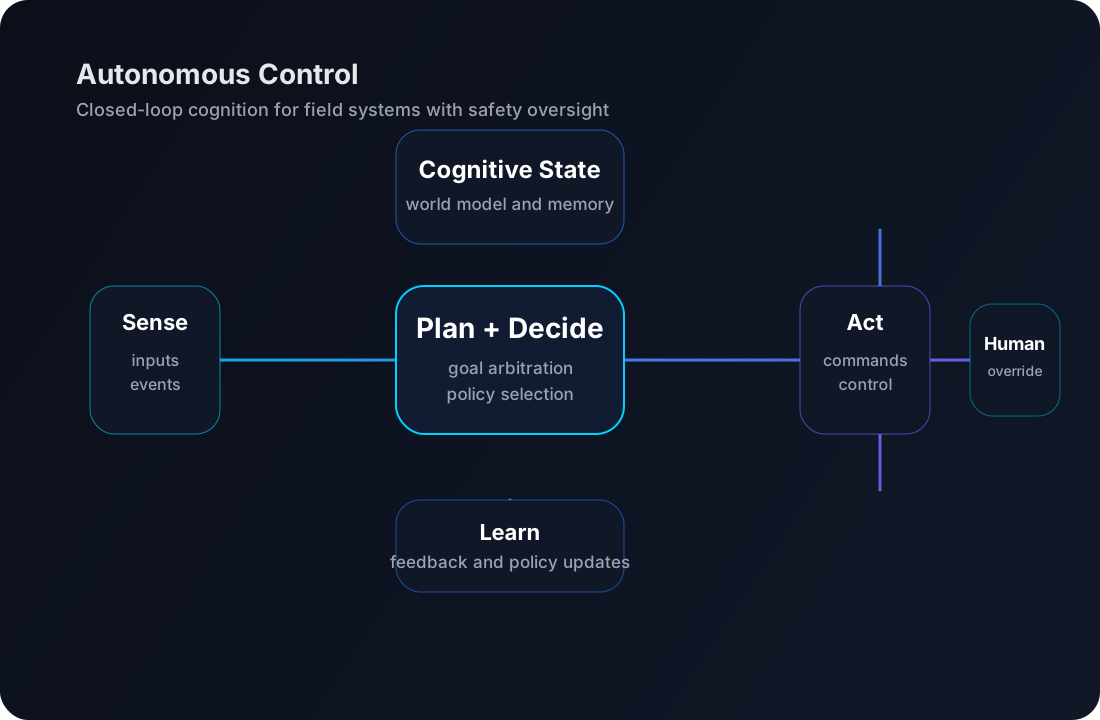
Control logic for systems operating in the world.
In physical systems, reasoning must remain connected to sensing, actuation, and fallback control. Cognitive AI provides the missing layer between perception and safe execution.
Fuse environment signals and state changes in real time.
Evaluate goals, hazards, human guidance, and policy limits.
Dispatch actions with verification, logging, and recovery paths.
Domain examples mapped to platform primitives.
Different applications stress different aspects of the platform. What remains consistent is the need for memory-backed reasoning, configurable control policies, and deployment flexibility.
Emphasizes structured evidence context, retrieval accuracy, and procedural reasoning.
Emphasizes streaming event interpretation, adaptive hypothesis testing, and rapid response loops.
Emphasizes local control, human safety boundaries, and memory-aware planning under uncertainty.