Context Before Response
A system should understand the operating situation, history, objective, actors, and constraints before producing an answer or taking an action.
Cognivanta Labs works at the intersection of cognitive intelligence, enterprise systems, autonomous technologies, and human-machine collaboration. We study systems that understand context, reason responsibly, and remain accountable to people and organisations.
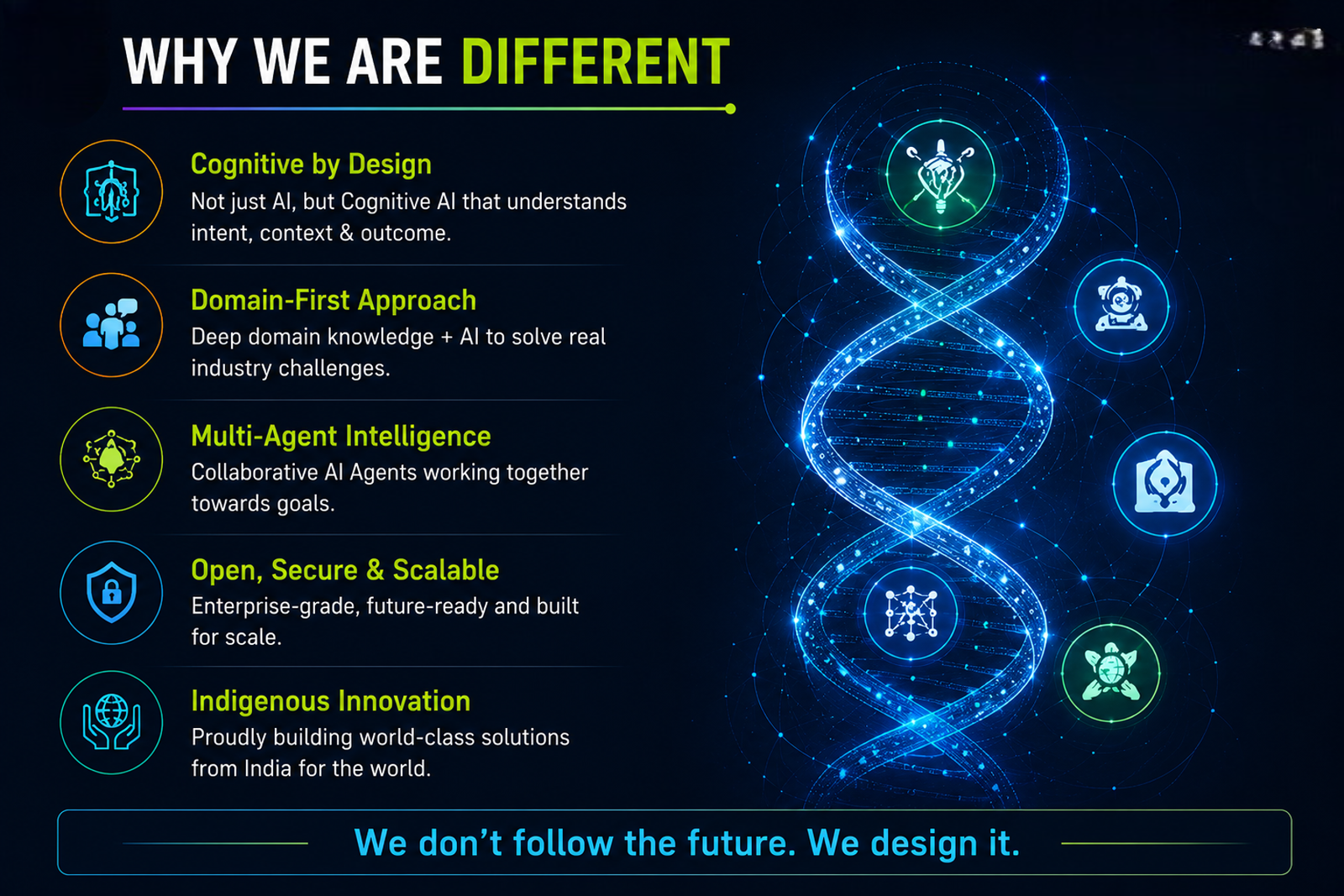
AI has advanced rapidly in language, perception, and pattern recognition. Yet enterprise and autonomous systems still struggle with continuity, operational context, governed decision-making, explainability, and accountable execution.
The objective is not to imitate human cognition literally. It is to create computational systems that operate with greater awareness, continuity, discipline, and accountability.
Capabilities under investigation
Multimodal perception
Intent understanding
Persistent context
Short and long-term memory
Knowledge representation
Contextual and causal reasoning
Multi-scenario decision evaluation
Policy and permission controls
Human oversight
Safe action execution
Outcome-driven learning
Auditability and lineage
Six principles guide research into systems that think before they act.
A system should understand the operating situation, history, objective, actors, and constraints before producing an answer or taking an action.
Intelligent systems should preserve relevant state and learn from previous interactions instead of treating every event as isolated.
Actions should follow structured evaluation of evidence, alternatives, policies, risks, and expected outcomes.
Permissions, safety boundaries, accountability, and human intervention must remain integral to intelligent operation.
Foundational cognitive capabilities should be reusable across industries rather than rebuilt separately for every application.
Platform research should be tested through practical domain systems, pilots, simulations, and operational feedback.
Architectures that connect perception, intent, context, memory, reasoning, decisions, action, and learning into a continuous system.
Cognivanta Labs applies platform research through focused domain programmes, testing cognitive capability against the constraints of real operational environments.

Context-aware healthcare systems, clinical information reasoning, consent, patient journeys, governance, medical workflows, and responsible decision support.

Drones, UAVs, UAS, mission intelligence, fleet coordination, telemetry reasoning, edge autonomy, simulation, and governed aerial operations.

Explainable financial intelligence, market context, portfolio reasoning, risk interpretation, and governed decision support.

Document understanding, legal context, case relationships, regulation analysis, evidence reasoning, and explainable legal assistance.

Human-machine coordination, task intelligence, sensor fusion, safe action execution, and adaptive physical systems.

Decision workflows, organisational memory, operational context, process intelligence, and governed automation.
Findings do not remain isolated in papers or demonstrations. Each research question travels a deliberate path so a discovery in one domain strengthens the shared platform for every future application.
Research through CINTENT
CINTENT provides the architecture through which Cognivanta Labs turns research into reusable enterprise capability exposed as engines, services, and governed workflows.
Explore CINTENTIntent and context engines
Cognitive memory
Knowledge graphs
Reasoning services
Decision intelligence
Governance engines
Multi-agent orchestration
Action services
Learning loops
Simulation
Observability
Audit and lineage
These are evaluation questions, not published performance claims. The right measure depends on the domain, risk, and operating environment.
Can the system distinguish supported evidence from an assumption or an unsupported inference?
Does it respect permissions, policies, risk boundaries, and human approval requirements?
Can a reviewer understand the context, alternatives, decision, and action path?
When context is incomplete or a tool fails, does the system pause, recover, or ask for help appropriately?
Every programme considers a shared set of responsibilities. Research involving healthcare, finance, legal decisions, autonomous operations, or sensitive data requires domain-specific review before real-world deployment.
Cognivanta Labs conducts applied research in cognitive intelligence, enterprise AI, decision systems, memory, reasoning, governance, autonomous systems, and human-AI collaboration.
No. Cognivanta Labs is a deep-technology company that combines applied research, platform engineering, domain development, and enterprise implementation.
CINTENT is the platform through which research outcomes are converted into reusable cognitive capabilities, APIs, workflows, runtime services, and domain intelligence.
Research output may include papers, technical notes, architecture reports, white papers, conference material, and domain studies. Publication status is stated for every item.
Yes. Collaboration may include joint research, internships, platform experimentation, publications, domain studies, and technology-transfer programmes.
Yes. Enterprises can propose domain problems, pilot opportunities, operational simulations, and collaborative research programmes.
Research is expected to follow security, privacy, human-oversight, explainability, and domain-governance requirements before real-world implementation.
Bring a hard problem, not just a model. Tell us what the system must understand, what it must never do, and what evidence a person needs before acting.