
Autonomous Wheelchair (AWCS)
Assistive mobility with safe navigation, human override and intelligent context under constrained, real-world conditions.
The Autonomous Wheelchair (AWCS) is an assistive mobility system focused on safe navigation, human override, and intelligent context awareness under constrained, real-world conditions — mobility that respects the rider's autonomy while reasoning continuously about the space around them.
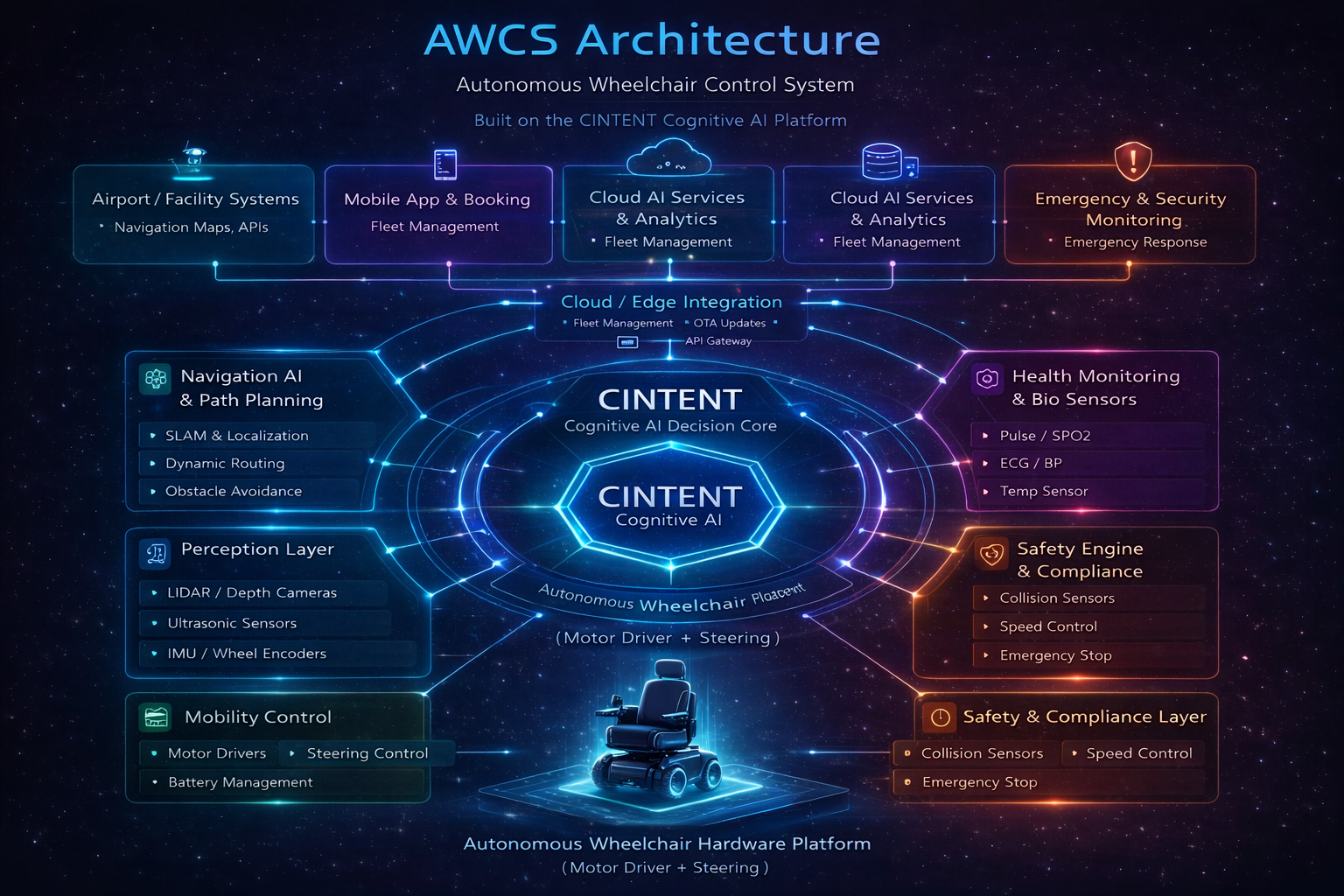
What Autonomous Wheelchair (AWCS) actually does.
Safe navigation
Continuous perception and path-planning tuned for indoor and mixed pedestrian environments.
Human override, always
The rider retains control at every point — autonomy assists, it doesn't replace, the person's decisions.
Intelligent context
Understands doorways, ramps, crowds, and obstacles as situational context, not just as static geometry.
Constrained-condition reliability
Designed to hold up under the real, imperfect conditions of everyday mobility — not just a clean test course.
The layers underneath.
User experience
Voice, mobile, touch, gesture, accessibility, feedback and notification surfaces keep the rider and operators in control.
Intent understanding
Translates rider goals, travel intent, preferences, accessibility needs and context into an explicit mobility request.
Perception and context
Combines obstacle, human, scene, location and situational signals into a live understanding of the environment.
CINTENT cognitive core
Applies memory, reasoning, planning, learning, safety and ethics to produce explainable, constrained mobility decisions.
Orchestration and execution
Turns approved decisions into task scheduling, route planning, adaptive navigation, real-time control and monitored execution.
Ecosystem integration
Connects approved airport, building, healthcare, IoT, emergency, cloud and third-party services through governed interfaces.
Data and knowledge
Stores governed knowledge graphs, user profiles, experience memory, context and policy rules to support continuous improvement.
Observability and governance
Preserves explainability, audit logs, monitoring, safety compliance, security, privacy and ethical oversight.
Currently in pilot — an assistive-autonomy program testing CINTENT's constraint reasoning where safety and human dignity are the primary design constraints.
Every product here runs on the same shared cognitive core.
Intent, context, memory, reasoning, orchestration and governance — unified, so Autonomous Wheelchair (AWCS) reasons the same way every other product does.